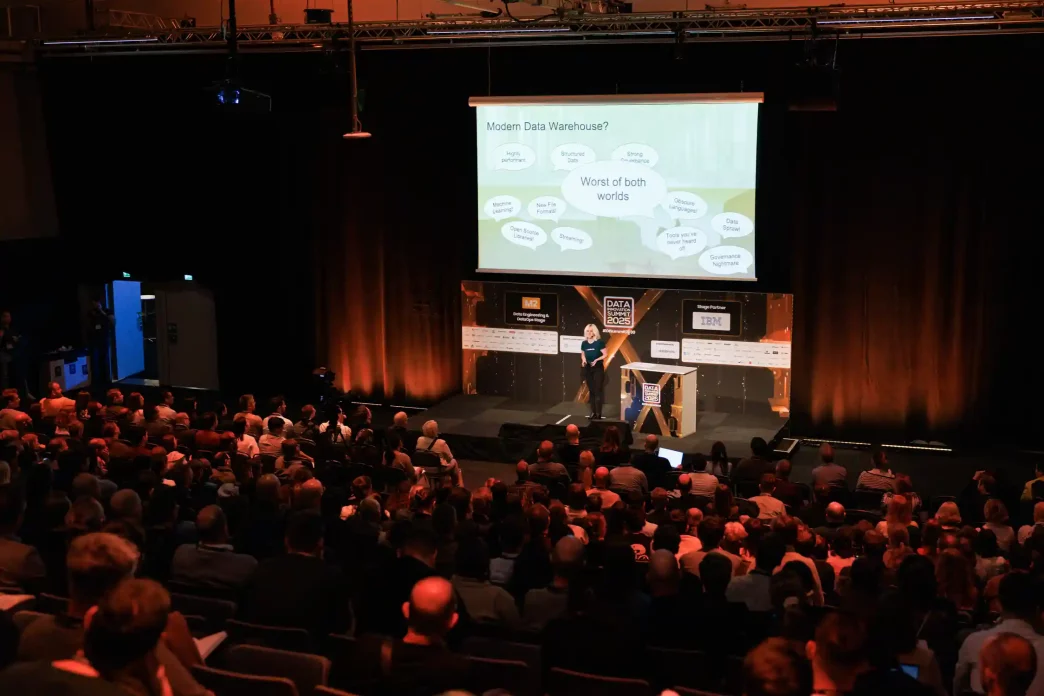
Most conference archives are a record of who was popular in a given year. The Data Innovation Summit‘s ten-year archive is something more useful than that: read in order, its keynote rosters and exhibitor floors form an unusually accurate map of how the data and AI industry actually moved, era by era, from big data infrastructure to today’s agentic systems. Because the event has always favored practitioners over professional speakers, that map reflects what organizations were actually building in a given year, not what a marketing calendar decided was trending.
Key Takeaways: 10 Years of Data & AI Evolution
- 2016–2017 (Big Data Infrastructure): Early summits focused on Hadoop, storage at scale, and academic research with legacy BI leaders like Cloudera, Teradata, and IBM.
- 2018–2019 (Applied Machine Learning): Shifted toward practical ML, highlighted by Hadoop creator Doug Cutting’s keynote bridging infrastructure to AI.
- 2020–2021 (Global Expansion & Resiliency): Enterprise research scaled internationally with leaders from Volkswagen AI, Smart Dubai, and data strategy expert Bill Schmarzo.
- 2022–2023 (Boardroom & Corporate AI): AI reached corporate governance, featuring Google’s Cassie Kozyrkov and Wallenberg Investments Chair Marcus Wallenberg.
- 2024–2025 (Government & AI Policy): Public policy took center stage with speakers from the Swedish AI Commission and Sweden’s Minister for Public Administration.
- 2026 (Agentic AI & Engineering): Production-grade agentic systems and security anchored by Joe Reis (Fundamentals of Data Engineering), Samsung Semiconductor, and Sferical AI.
- Exhibitor Floor Shift: Documented the tool landscape evolution from Hadoop clusters to cloud warehouses (Snowflake, Databricks) and modern AI observability tools (Monte Carlo, Validio, Weights & Biases).
The summit’s earliest editions, held in Stockholm, reflected the industry it was born into: a world still working out the operational basics of “big data” before machine learning had become a boardroom concern. Early keynote rosters leaned heavily on academic and applied research voices, including Johan Magnusson from the University of Gothenburg’s Informatics division and Diego Galar, a professor whose work on predictive maintenance would eventually anchor an entire spin-off event. Practitioners from Nordic industrial giants were present from the very first editions too. Anders Arpteg, now VP of AI & Data at Saab, spoke at the inaugural event in 2016 and has appeared on a Hyperight stage in nearly every year since, making his personal speaking history almost a parallel timeline of the industry’s own maturation.
The exhibitor floor from this period tells the same story from the vendor side. Early editions were dominated by the established big data and business intelligence stack: Cloudera, Teradata, Informatica, Talend, Qlik, Tableau, SAP, and IBM, companies whose entire product categories were built around the Hadoop-era assumption that the hardest problem in data was storage and processing at scale, not intelligence layered on top of it.
2018–2019: The bridge between big data and machine learning
By 2018 and 2019, the agenda began visibly shifting from infrastructure toward applied machine learning, without ever abandoning the summit’s insistence on practical, implementation-first content. Perhaps no single booking captures that bridge better than Doug Cutting, the creator of Hadoop himself, appearing on stage at the 2019 edition. Having the person who defined the big data era speak at the same event that was already pivoting toward machine learning and AI was less a nostalgia booking than a signal: the summit was positioning itself as the place where one era of the industry handed off to the next, rather than starting over with a new conference brand every time the technology moved.
This period also marked the beginning of a recurring cast of enterprise technologists who would return across multiple editions, including Stephen Brobst, CTO of Ab Initio Software, whose appearances span from 2018 through 2026, and Martin Willcox, then EMEA VP of Technology at Teradata. Their sustained presence across nearly a decade gives the archive something rare among industry conferences: the ability to trace how the same senior technologists’ own thinking evolved in step with the industry, rather than reading the perspectives of a different set of speakers every year.
2020: Global reach tested by a pandemic
The 2020 edition landed at one of the most difficult moments in the modern events industry, and the content roster from that year reflects an organization choosing depth over retreat. Patrick van der Smagt, Director of Fundamental AI Research at Volkswagen AG, brought one of the most advanced corporate AI research functions in Europe onto the stage, while H.E. Younus Al Nasser, Assistant Director General of Smart Dubai, represented the summit’s first serious extension of its content into the Middle East, a region that would later host its own dedicated Data 2030 Summit MEA editions. Daniel Gillblad, Chief of AI at Recorded Future, rounded out a roster focused less on pandemic disruption and more on where applied AI research was actually heading, a decision that positioned the summit well for the acceleration that followed. 
2021: Proving the format could survive disruption
The 2021 edition is best remembered as one of the first full-scale live expos in Europe to run in the immediate aftermath of pandemic restrictions easing, a decision that reflected the same community-first instinct behind the event’s founding: the delegates and exhibitors needed the room back, so the room came back. The content matched that resilience theme. Bill Schmarzo, known across the industry as the “Dean of Big Data,” and Caroline Carruthers, who would go on to speak at multiple future editions and at the Data 2030 Summit specifically, both anchored a program focused on data monetization and organizational data strategy at a moment when many enterprises were reassessing their data investments under real financial pressure.
2022–2023: The industry goes global, and the boardroom starts paying attention
If there is a clear before-and-after moment in the summit’s decade, it sits across these two editions. In 2022, the keynote roster expanded well beyond Nordic and European voices: Cassie Kozyrkov, Google’s ex Chief Decision Scientist, brought one of the most recognized names in applied AI decision-making to the Stockholm stage, Virginia Dignum from Umeå University addressed AI ethics at a moment when the EU AI Act was moving from proposal toward law, and Rainer Deutschmann, at that time COO of Telia, signaled that the summit’s relevance had extended well past Europe.
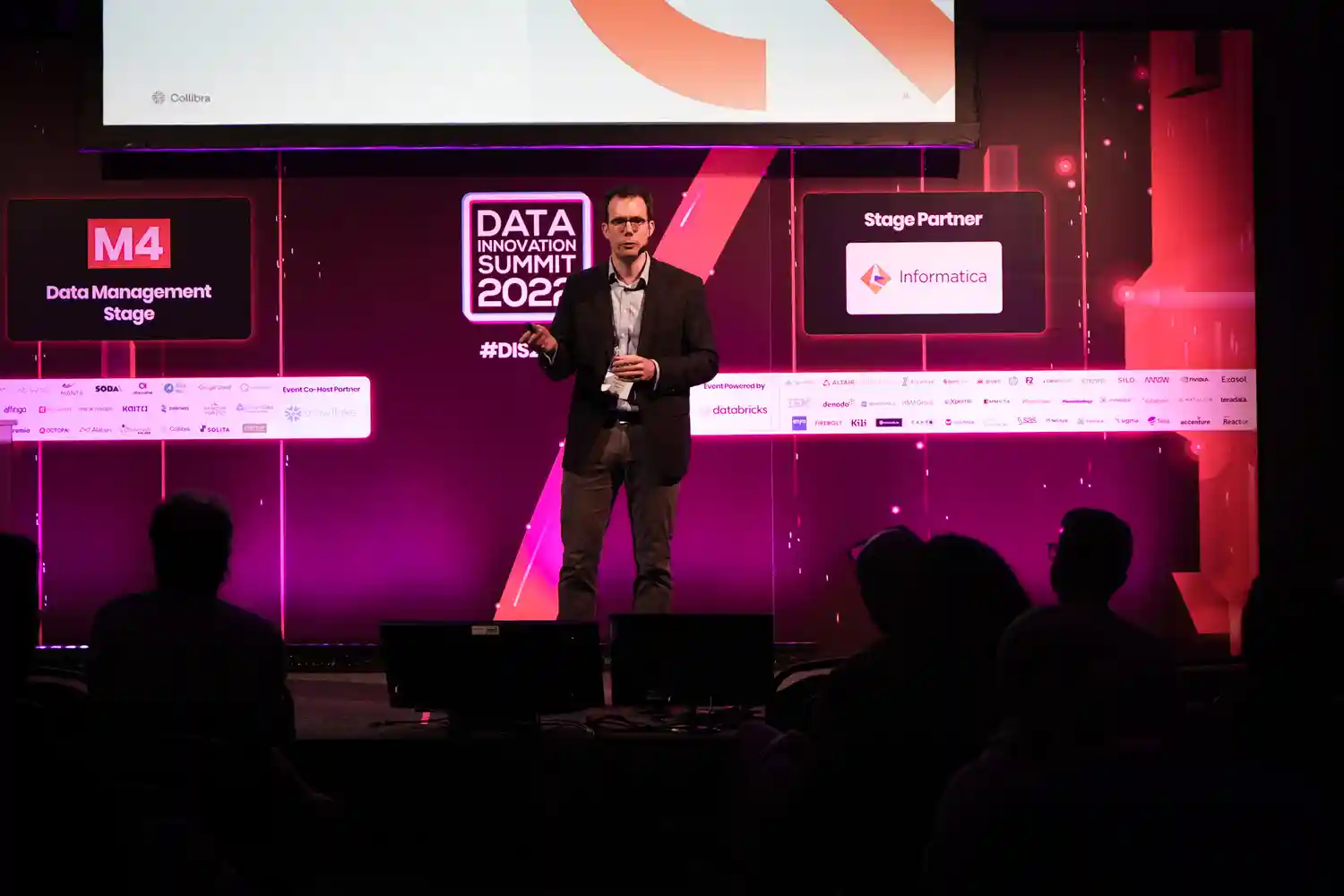
Then, in 2023, the summit reached a different kind of milestone entirely: Marcus Wallenberg, Chair of Wallenberg Investments AB and one of the most consequential figures in Swedish and Nordic corporate governance, appeared on stage. A speaker roster that had built its credibility for seven years on the strength of practitioners and technical researchers had, by 2023, become a venue that could also draw the very top of Nordic corporate leadership, evidence that data and AI maturity had genuinely become a board-level concern rather than a departmental one.
2024–2025: Government and institutional legitimacy
The following two editions extended that institutional weight into public policy directly. Carl-Henric Svanberg, Chairman of the Swedish AI Commission, spoke at the 2024 edition as national AI strategy was being formalized at the government level, while Erik Slottner, Sweden’s Minister for Public Administration, addressed the 2025 edition directly, marking the clearest instance yet of a sitting government minister engaging with the summit’s audience on their own terms. Alongside this, global enterprise voices such as Caitlin Halferty, curently Head of Data & Analytics at Thomson Reuters, and Uthman Ali of BSI speaking specifically on AI ethics, showed the summit balancing its Nordic institutional roots with a genuinely international enterprise audience.
2026: The agentic era, and the return to fundamentals
The most recent edition reflects where the industry’s real conversation has moved: beyond generative AI experimentation and into agentic and embedded systems that require production-grade engineering discipline. Fittingly, the 2026 keynote roster paired Joe Reis, best-selling author of Fundamentals of Data Engineering, with Anders Ynnerman, Executive Chairman of Sferical AI, alongside Fredrik Reinfeldt, Sweden’s former Prime Minister, and Kevin Shin, Head of Information Security at Samsung Semiconductor. That combination, foundational engineering literacy, frontier AI leadership, statesman-level policy credibility, and enterprise security, captures a summit that has learned, across a decade of shifts, that no single narrative about AI is ever the whole story. The hyperscaler and platform presence deepened in parallel, with Snowflake, Google Cloud, NVIDIA, and Siemens all sending senior regional leaders to the stage rather than sales representatives to the booth.
What the exhibitor floor adds that the keynote stage can’t
The keynote roster tells the story of ideas moving through the industry. The exhibitor floor tells the story of tools moving through it, and the two rarely move in perfect sync. Across a decade, the summit’s exhibitor list has quietly documented nearly the entire evolution of the modern data and AI stack: the Hadoop-era leaders of the founding years giving way to cloud data warehouses like Snowflake and Databricks, then to the modern data stack built around dbt Labs, Fivetran, and Confluent, and most recently to an entirely new category of AI-native infrastructure and governance tooling, including Weights & Biases, SambaNova, Silo AI, and a cluster of AI observability and evaluation vendors such as Monte Carlo, Validio, Giskard, and Kolena that simply did not exist as a product category when the summit began. Hundreds of these companies used the Stockholm stage as a genuine launchpad into the Nordic and wider European market, which means the exhibitor archive isn’t just a record of who sponsored the event. It’s a record of which parts of the data and AI tooling landscape actually took hold in the region, and roughly when.
Taken together, the keynote and exhibitor history of the Data Innovation Summit isn’t simply a list of who showed up each year. It is one of the more complete, practitioner-verified records available anywhere in Europe of how the data and AI industry actually moved, decision by decision, tool by tool, from the Hadoop era to the agentic one.