
Two years ago, IKEA’s AI Lab was a modest team of five data scientists holding a handful of bold ideas about Generative AI. Fast forward to today, and that small unit has expanded into a strong pool of more than 20 data scientists and engineers. More importantly, they aren’t just running experiments, they have models running live in production, actively powering operations for Ingka Group (IKEA’s largest franchisee, operating over 500 stores across 32 markets and employing 160,000+ co-workers worldwide). That pool of experts is more than needed, considering that the IKEA app has more than 20 million downloads and has many visitors on their online and offline stores.
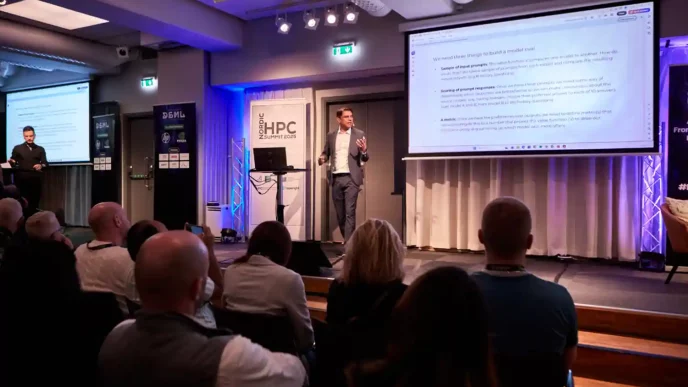
At the previous edition of the Nordic Data Science & Machine Learning Summit (NDSML), María García, Lead Data Scientist at Ingka Group, took the stage to showcase how one of the world’s most iconic brands moves GenAI from isolated lab explorations to real-world deployment, and ultimate business value.
Here is a glimpse into how IKEA is bridging the gap between imagination and retail reality, and why their framework for AI adoption is a masterclass for modern enterprise leaders.
Unlocking Unstructured Intelligence
For years, traditional machine learning at IKEA has optimized supply chains, predicted product demand, and fine-tuned pricing. But as María highlights, the vast majority of high-value enterprise data remains unstructured and from room images and blog posts to millions of customer support conversations.
Enter Generative AI, Vision Language Models (VLMs), and Agentic workflows.
By applying multimodal architectures to this unstructured mountain of data, IKEA isn’t just adopting technology for technology’s sake. Every model in production is bound strictly to three distinct value pillars: 
- Growing the Business: Enhancing cross-selling and upselling naturally (e.g., helping customers “Complete the Look” by interactively furnishing room categories like study and dining rooms).
- Improving Efficiency: Automating manual friction in daily operations to lighten the load for human co-workers.
- Enhancing Experience: Meeting millions of customers with hyper-personalized, inspiring touchpoints, wherever and however they shop.
6 Real-World Applications Powering the IKEA Ecosystem
During her presentation, María outlined six concrete production and testing use cases currently transforming the IKEA ecosystem:
- “Complete the Look”: Interactive 3D asset generation that lets online shoppers swap out rugs, chairs, and storage in real-time, yielding measurable lifts in add-to-cart rates.
- Multi-Touchpoint Visual Intelligence: Computer vision pipelines that empower store co-workers to identify tagless returns instantly, streamline listings on IKEA’s Second Hand platform, and generate precise visual product recommendations from a customer’s Pinterest pin or social media upload.
- Automated Metadata Enrichment: Utilizing multimodal models to auto-tag vast image catalogs with accurate key-value attributes alongside subject matter experts.
- Instant Room Furnishing (Agents & RAG): Deploying agentic workflows, 3D assets, and interior design logic to generate optimized, fully furnished room layouts in the blink of an eye for business customers.
- Reviews Insights Pipeline: An NLP workflow originating from a master’s thesis that clusters thousands of app and store reviews into micro-topics, generating action-item summaries for product managers.
- Active Selling Agents: Real-time co-worker support tools that flag out-of-stock items, recommend missing essentials (like a mid-beam for a bed frame), and suggest relevant member discounts right on the store floor.
Structure, Golden Datasets, and Culture
“You can’t scale innovation without structure. But you also can’t innovate if you overstructure.”
How does an enterprise giant balance rapid experimentation with rigid corporate systems? According to María, the key lies in a disciplined 40/60 rule:
40% Applied Research (reading papers, testing cutting-edge techniques with mid-to-long-term payback)
60% Value Delivery (working directly with digital product teams to land value within 3-6 months)
To prevent innovation from turning into chaos, the team relies on time-boxed hypotheses, early benchmarking, and Golden Truth Datasets curated alongside domain experts. By pairing human-in-the-loop validation with “LLM-as-a-Judge” metrics, IKEA ensures their teams are actually moving metrics.
Equally critical is human enablement. Change management at an 80-year-old brand requires meeting non-technical stakeholders where they are: leading with short video demos and plug-and-play micro-apps rather than model leaderboards, and framing GenAI as an augmentation tool for co-workers, not a replacement.
More Insights To Be Unlocked
This is just the surface. How exactly does IKEA build their Golden Datasets? How do they balance LLM observability with cost, and what specific frameworks keep their multi-agent workflows from hallucinating on product attributes?
The complete, unedited presentation by María García, along with dozens of other exclusive keynotes from industry pioneers at NDSML is available on Hyperight.com.
Become a Hyperight Premium Member today to unlock full video access to this talk, deep-dive presentations, slides, and exclusive interviews from the front lines of enterprise AI implementation.